Introduction
GEF-9 has begun, and one of its clearest invitations to civil society is now open. The GEF SGP CSO Challenge offers grants of up to $300,000 to help civil society organizations scale environmental solutions that already work.
On July 7, 2026, around 100 people from around the world joined Session 6 of the Whole of Society Talks to hear directly from the people behind the program.
Sagar, Vice Chair of the GEF CSO Network, hosted the conversation. He was joined by Gabriella, who leads the GEF Small Grants Program (SGP), Joshua, GEF and GCF Portfolio Manager for Global Programs at IUCN, and Justin, Senior Energy Economist at RTI International.
By the close of the hour, participants voiced their thanks and said the session left them feeling more confident, and inspired, to apply.
Session Objectives
Sagar opened by returning to the idea behind the whole series. A whole-of-society approach to GEF-9 only works if the whole of society gets heard, including grassroots groups, Indigenous organizations, youth networks, and civil society actors doing the work on the ground.
Earlier sessions had surfaced a consistent message. Entry barriers, unclear processes, and limited support keep smaller and first-time organizations from applying with confidence. This session set out to:
- Introduce the CSO Challenge and how it differs from the core Small Grants Program
- Walk through the application process, step by step, with resources applicants can use right away
- Clarify eligibility questions that keep coming up, directly from the people who review applications
- Open the floor so applicants get a direct chance to ask questions and get answers in real time
Speaker Insights
Gabriella – GEF Small Grants Program
Gabriella Richardson Temm leads the GEF Small Grants Program and has spent more than 25 years advancing social inclusion and sustainability in global conservation.
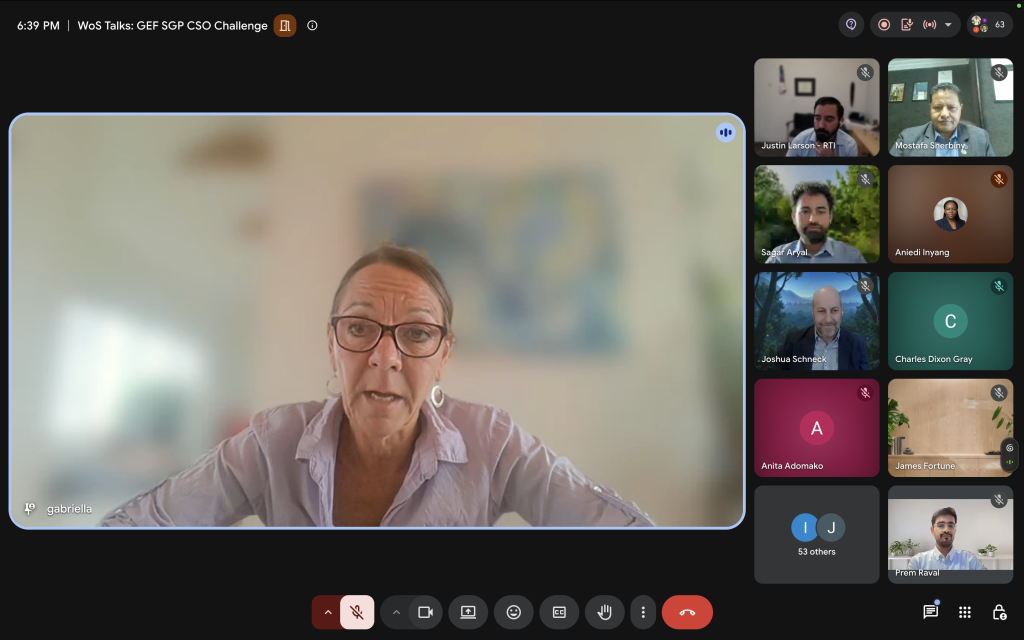
Gabriella opened with the history behind the program. The Small Grants Program started as a small pilot in 1992. Over more than 30 years, it has grown into one of GEF’s largest corporate programs, reaching 136 countries with close to $1.5 billion across 30,000 grants. It runs on a decentralized model, with national steering committees in each country and grants typically between $20,000 and $50,000, capped at $75,000.
The Challenge grew out of conversations during the GEF-8 replenishment, when the team began exploring ways to help organizations scale beyond what the core program supports. Gabriella was direct about the distinction. The Challenge does not fund new ideas. It looks for organizations that have already proven an approach works and are ready to take it further. She credited IUCN for leading the program and RTI for building its infrastructure, and noted that the funding runs alongside existing country allocations, not out of them.
Joshua – IUCN
Joshua Schneck manages IUCN’s portfolio of GEF and GCF funded global programs, worth more than $55 million, and previously coordinated a $59 million program restoring forests across ten countries.
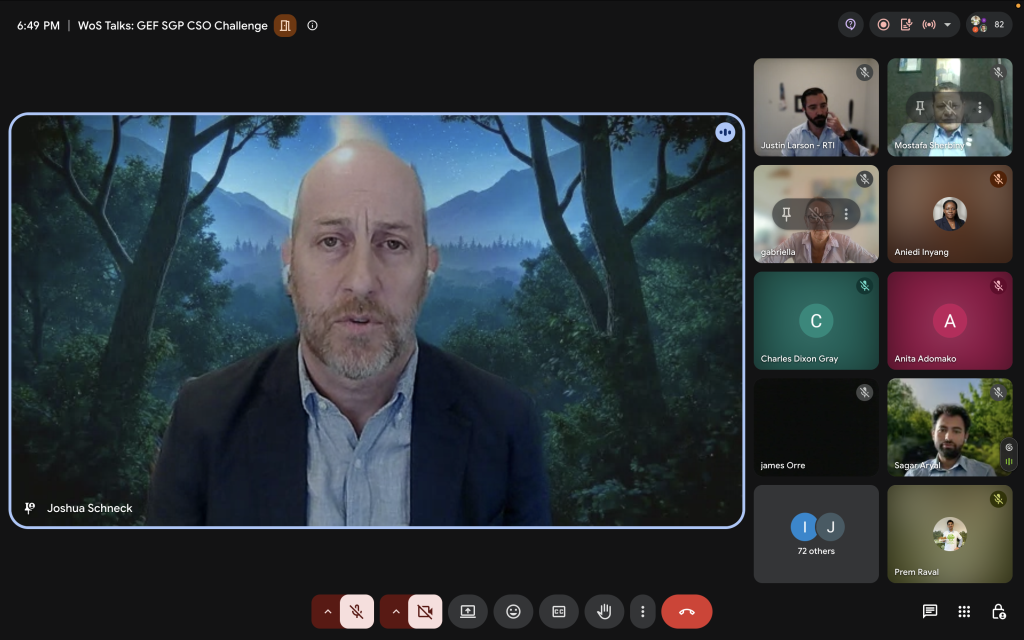
Joshua laid out what sets the Challenge apart. Grants run up to $300,000, decided by a single global selection committee rather than country-level ones. IUCN is looking for organizations with a proven record of impact and the capacity to manage a grant of this size.
He walked through the criteria the review committee uses: a proven track record of achievement, potential for global environmental benefit, innovation in a broad sense, whether that means a new model, a new technology, or a new partnership, financial viability, scalability, and a genuine commitment to sharing what they learn.
Joshua also pointed to something beyond the money. Every winning organization, along with an equal number of semi-finalists, will develop a case study through IUCN’s Panorama platform. The program plans a minimum of 48 case studies, four regional cohort events, and a series of peer exchanges over its four-year life. As he put it, this is a small amount of funding against the scale of the world’s environmental challenges, so capturing and spreading what works matters as much as the grant itself.
Justin – RTI
Justin Larson is a Senior Energy Economist at RTI International, with more than 15 years advancing clean energy and energy access across North America, Africa, and the Asia-Pacific.
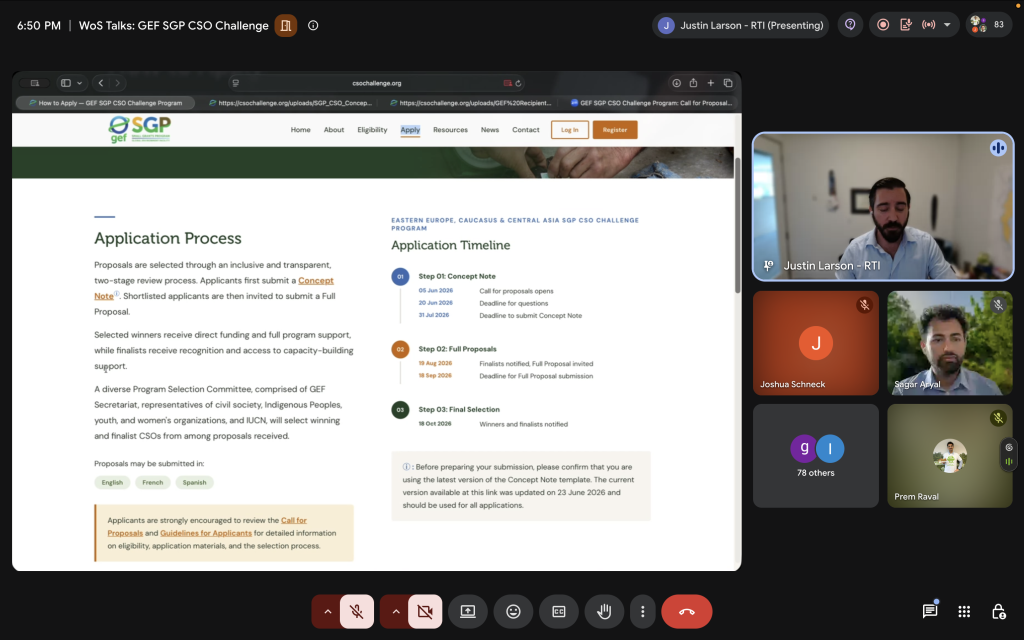
Justin took the group through the practical side. Almost a thousand people have already registered on the grant portal, with hundreds of questions submitted, a clear sign of the interest this call has generated.
He showed where everything lives on the program website, csochallenge.org, including the guidelines, resource documents, and country eligibility lists. The process runs in two stages, a concept note first, then a full proposal only for those who pass that round. As Justin explained it, nobody should have to write a full proposal only to learn later they were never eligible.
Only one regional window is open right now, for Eastern Europe, the Caucasus, and Central Asia. Africa, Latin America and the Caribbean, and Asia-Pacific are expected to open around August 1, 2026, running in parallel. Applications go through the online portal only, as a PDF, with no email or Word submissions accepted and no late entries once the window closes.
The Five Priority Areas
Every proposal needs to fit within at least one of these. Overlap between areas is common and welcome, as long as the application is clear about its main focus.
- Sustainable agriculture, fisheries, and food security
- Chemicals and waste management, including plastic and mercury pollution
- Community-based management of threatened ecosystems and species
- Low-carbon energy access
- Sustainable urban solutions
From the Open Floor
The questions came fast once Sagar opened the floor, and they gave the session its real texture. Applicants from Nigeria, Kenya, Ghana, and beyond asked the questions most people in the room were likely thinking.
Aliyu asked whether the Challenge favors a specific sector. Justin’s answer was direct: any of the five priority areas qualifies, and reviewers bring matching sector expertise to each one.
Aniedi asked whether organizations need a history with GEF to compete. Justin said no, and added that he doubts the final group of winners will all have prior GEF experience. The goal is funding good ideas with proven impact, not rewarding past recipients.
William, who runs a livestock association supporting 7,000 farmers, pushed on what counts as innovation, since the word means different things to different funders. Justin’s answer set a clear line: innovation here means a proven approach that has not been widely adopted yet, not a first-time pilot.
Eddy asked about organizational age and financial thresholds. Gabriella confirmed there is no minimum on either.
Ailars asked whether youth-led organizations and regional consortia can apply. Justin and Gabriella answered with visible enthusiasm. Yes, to both.
Samuel asked how many organizations will be selected globally, and whether a proven idea from one country can be replicated in another. Justin answered plainly: at least 24 awards across all four regions, and yes, replication across countries is exactly the kind of scaling the program wants to see.
Throughout, Sagar returned to one point. Any question about eligibility or the call itself would be answered for everyone, not just the person asking, to keep the process fair for the full applicant pool.
Closing Reflections
With time running short, Sagar thanked Gabriella, Joshua, and Justin for staying generous and specific with their answers, and thanked everyone on the call for the quality of their questions. Several participants shared their appreciation before logging off, saying the conversation had made the process feel clearer, and left them inspired to apply.
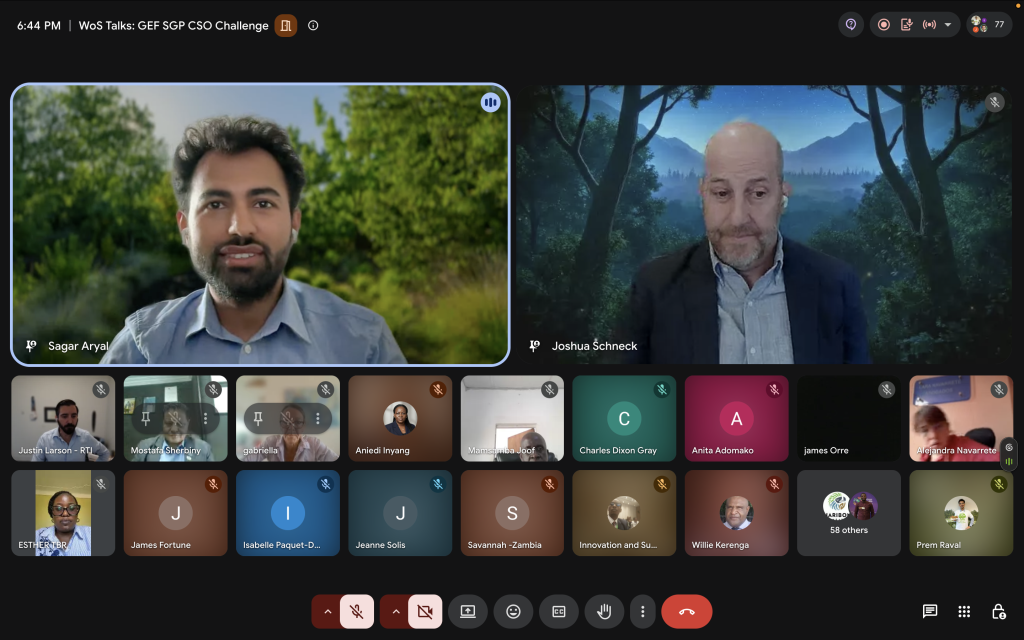
Sagar closed with an invitation. Anyone planning to attend the CBD COP in Armenia or COP31 in Turkey and interested in collaborating with the CSO Network beyond this call was asked to reach out. A recording of the session, along with Justin’s resources and a short feedback survey, will go out to everyone who registered.
His final message summed up the hour. Do not let the barriers discussed today hold you back. If you are a small grassroots organization or a first-time applicant, this challenge is for you too.
Stay tuned for Session 7 of the Whole of Society Talks series.